+86-13381525161


Author: Site Editor Publish Time: 07-15-2026 Origin: Site


Misting nozzles are widely used in industrial cooling, dust suppression, greenhouse humidity control, and process engineering systems. Although they appear simple from the outside, their internal working mechanism involves complex fluid dynamics and precise structural engineering.
Understanding how misting nozzles generate fine droplets is essential for system design, nozzle selection, and performance optimization.

A misting nozzle is not just a hole that sprays water. It is a precision fluid control device that transforms pressure energy into atomized droplets through controlled flow acceleration and turbulence.
Inside the nozzle, three main processes occur simultaneously:
Flow acceleration
Pressure conversion
Turbulent breakup
Engineering Insight
Atomization is not spraying — it is controlled fluid fragmentation.
Step 1: Pressurized Fluid Entry
Water enters the nozzle under controlled pressure (typically 2–70 bar depending on system type).
At this stage:
Flow is stable
Velocity is relatively low
Energy is stored as pressure
Step 2: Acceleration Through Internal Channel
The internal geometry of the nozzle gradually reduces flow area, causing velocity to increase.
According to Bernoulli’s principle:
Pressure energy decreases as velocity increases.
Step 3: Shear Force Generation
As fluid passes through narrow passages, shear forces develop between layers of liquid.
This is one of the most important stages in atomization.
Step 4: Exit Orifice Breakup
When fluid exits the nozzle orifice:
Pressure drops rapidly
Flow becomes unstable
Liquid breaks into droplets
Step 5: Droplet Formation and Dispersion
The broken liquid forms droplets, which are then distributed in a cone or fan-shaped spray pattern.
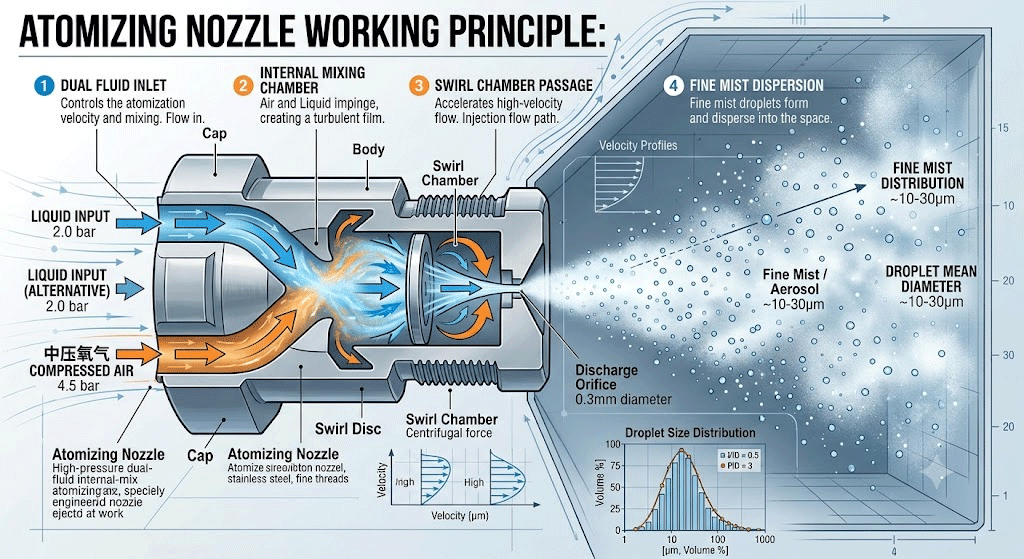
Misting nozzle atomization is governed by three main physical mechanisms:
3.1 Bernoulli’s Principle
Pressure decreases as velocity increases.
3.2 Surface Tension Breakdown
Liquid naturally resists breaking due to surface tension.
High velocity overcomes this force, forming droplets.
3.3 Turbulent Flow Instability
At high velocity, flow becomes unstable, leading to chaotic breakup.
Droplet size is determined by:
Pressure level
Orifice diameter
Internal turbulence intensity
Fluid viscosity
Droplet Size Classification
Droplet Size | Behavior | Application |
>100 μm | Heavy droplets | Cleaning |
50–100 μm | Medium evaporation | Dust suppression |
<50 μm | Fine mist | Cooling / humidification |
Engineering Insight
Smaller orifices + higher pressure = finer droplets.
5.1 Hydraulic Atomization
Uses water pressure only
Simple structure
Industrial cooling & dust suppression
5.2 Air-assisted Atomization
Uses compressed air + water
Produces ultra-fine droplets
Used in coating systems
5.3 Impact Atomization
Fluid collides internally
High turbulence
Fine droplet formation
After atomization, droplets are distributed based on nozzle geometry:
Flat Fan Pattern
Linear spray sheet
High impact density
Full Cone Pattern
360° uniform distribution
Even coverage
Hollow Cone Pattern
Ring-shaped distribution
Specialized industrial use
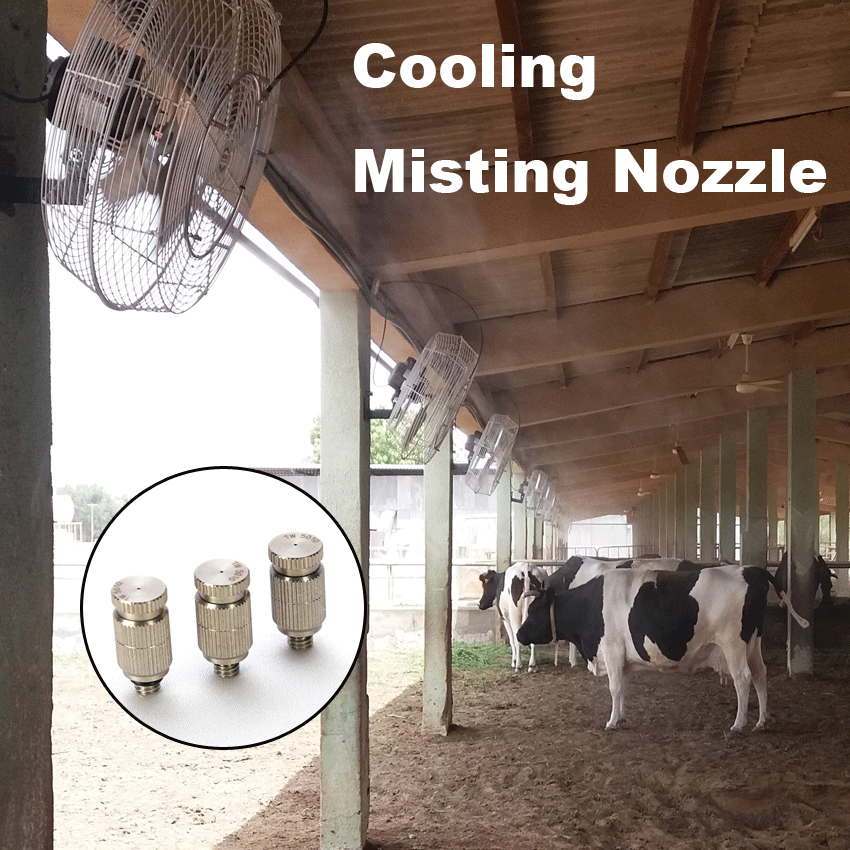
Misting nozzle performance depends on:
Operating pressure stability
Fluid cleanliness
Orifice precision
Installation angle
System pump matching
Critical Engineering Issue
Poor filtration causes clogging, which significantly reduces atomization efficiency.
Uneven droplet size
Nozzle clogging
Poor spray uniformity
Excess water consumption
Pressure fluctuation impact
The working principle of misting nozzles is based on controlled fluid acceleration, pressure conversion, and turbulent atomization. Understanding this mechanism is essential for designing efficient industrial spray systems.


